Claude Monet
Claude Monet, whose long and tireless life was an unwavering pursuit of the "impossible" capturing the very light itself and the fleeting breath of nature as it shifted before his eyes.

History
Claude Monet was the foundational figure of French Impressionism, born in Paris in 1840 and raised in the coastal town of Le Havre. His early career began with charcoal caricatures, but his path shifted dramatically after meeting Eugène Boudin, who introduced him to painting outdoors. Throughout the 1860s and 70s, Monet faced extreme financial hardship and professional rejection from the traditional art establishment, leading him and a group of like-minded artists to host their own independent exhibition in 1874. It was here that his painting, Impression, Sunrise, gave the movement its name initially as an insult from a critic. In his later years, Monet settled in Giverny, where he created his famous water lily pond and continued to paint even as cataracts clouded his vision, eventually dying in 1926 as one of the most celebrated artists in history.
Form/style
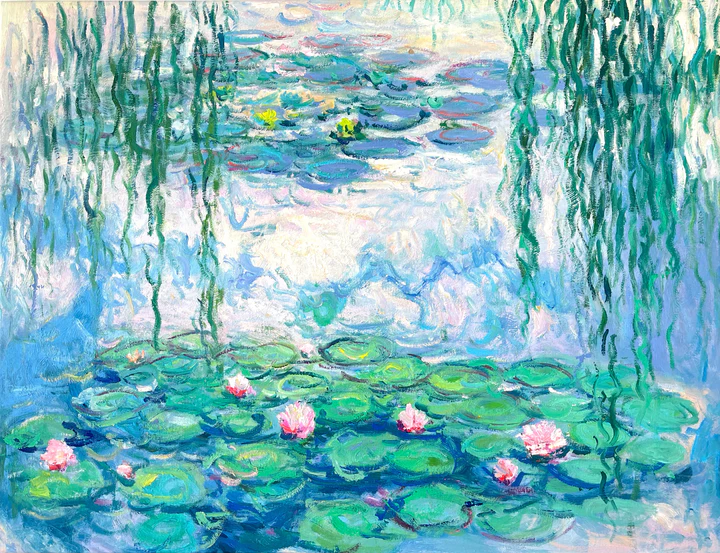
Monet’s style is defined by a rejection of traditional studio techniques in favor of capturing the fleeting effects of light and atmosphere. He utilized short, thick brushstrokes of "broken color" that allowed the viewer’s eye to optically mix the pigments from a distance, creating a sense of vibration and movement. Unlike the polished, hidden brushwork of the Renaissance, Monet’s canvases are textured and visceral, often leaving the white of the primer visible. He was famous for his "series" paintings, where he would paint the exact same subject such as Rouen Cathedral or haystacks at different times of day to document how sunlight and weather fundamentally changed the appearance of a form. By abandoning pure black and focusing on the "envelope" of air surrounding an object, he transitioned art from objective representation to subjective perception.

My appreciation
To appreciate Monet's work is to learn how to see the world as a mosaic of light rather than a collection of solid objects. There is a profound, meditative quality in his dedication; he could find an entire universe of color in a pile of hay or a lily pad. His work feels deeply personal because it captures a specific, unrepeatable moment in time, reminding us of the transience of life itself. In an age of high-definition digital clarity, Monet’s soft, atmospheric landscapes offer a necessary sensory escape, inviting the viewer to slow down and experience the emotional resonance of a sunset or a garden. His legacy isn't just in the beautiful images he left behind, but in the permission he gave future generations to prioritize their own internal "impression" over external reality.
"To see we must forget the name of the thing we are looking at."
Claude Monet
Create Your Own Website With Webador